
Lookup Valdosta Voter Registration
The Georgia My Voter Page, or MVP, is designed for a voter to verify information tied to that person's own registration. It reports registration status and information on file, polling place, early-voting sites, district and elected-official context, a sample ballot, absentee application and ballot status, and provisional-ballot status. It is free, but its dynamic Salesforce interface can use CAPTCHA.
The current login labels were not machine-readable during research, so they are not guessed here. Follow the fields MVP displays and enter the identifying values exactly as requested. If the system cannot confirm the registration, use the county office rather than trying random variations against a private directory.
| Lookup stage | What to provide or select | Result or next action |
|---|---|---|
| Open the official tool | Use the current identity and location fields shown by MVP | Complete any CAPTCHA or verification control |
| Review registration | Confirm the displayed name, address context, and status | Note any mismatch for Lowndes Elections |
| Check election details | Open polling, early-voting, district, ballot, or absentee panels | Use the data for the applicable election |
| Resolve a failure | Contact the official county custodian | Ask it to check the full county record |
The official My Voter Page screen is the statewide voter-facing entry for Valdosta residents.
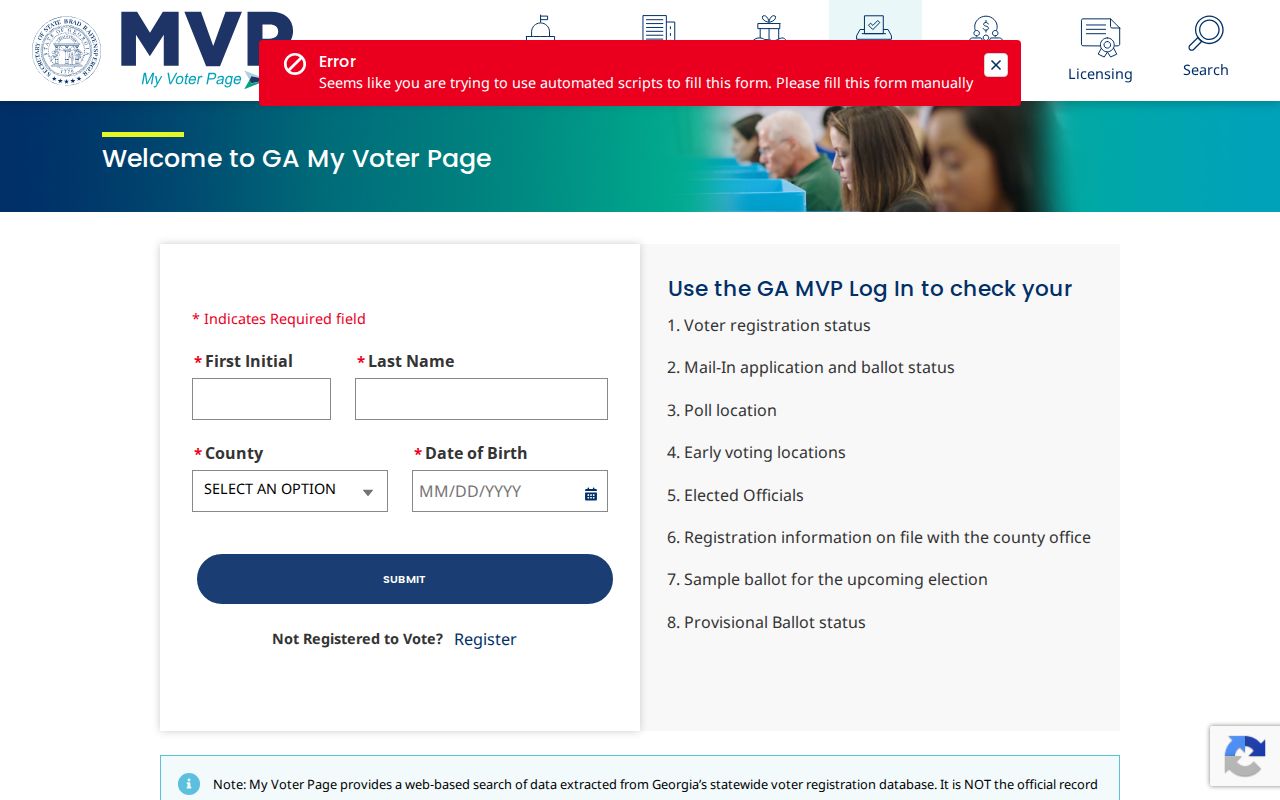
The portal gives voters a concise extract, not unrestricted access to the statewide voter file.
Who Holds Valdosta Voter Records
MVP expressly functions as an extract. The official Lowndes County voter registration record remains with Lowndes County Elections. That distinction matters when a portal value looks stale, an address was recently changed, or a status needs explanation. The office is at 2808 N. Oak Street, Valdosta, GA 31601, and is open weekdays from 8 a.m. to 5 p.m. Call 229-671-2850 or email elections@lowndescountyga.gov.
Bring or provide enough information for staff to identify the correct record. A voter can ask how to update the registration and which deadline applies, but should not assume an online mismatch has already changed the official file. County staff can also explain local precinct administration and election notices that sit outside the personal MVP extract.
The manifest's Lowndes Elections page identifies the local office and its election services.
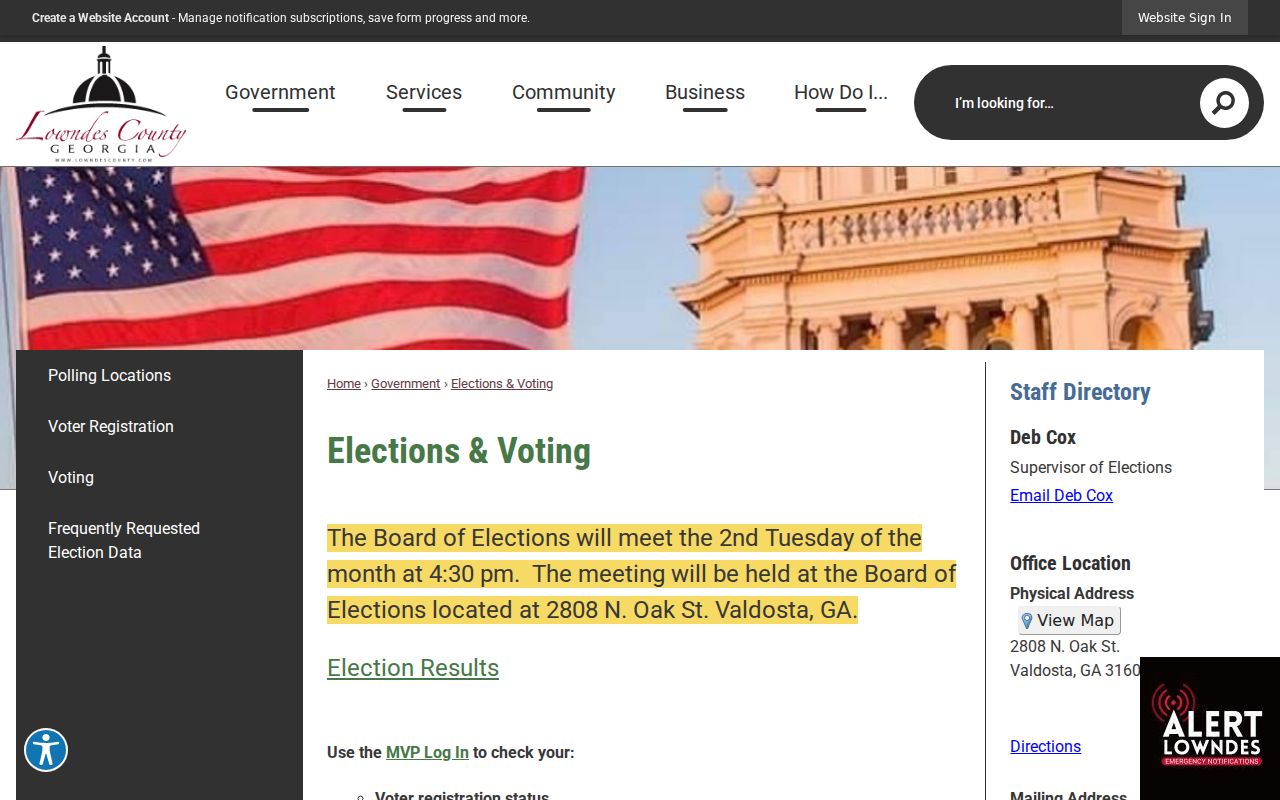
This county channel is the right fallback when statewide lookup data needs correction or confirmation.
Note: Portal absence does not establish that a Valdosta voter registration was cancelled or never existed.
What Georgia Voter Records Reveal
O.C.G.A. § 21-2-225 defines the public and confidential split. Public elector data can support civic analysis and list orders, but the law removes high-risk identifiers. Participation history means whether someone took part in an election and may include a last-voted date. It never shows choices marked on a secret ballot.
| Name | Part of the public elector record. |
|---|---|
| Residence address | Generally public, subject to protected-voter rules. |
| Birth information | Birth year may appear; month and day are confidential. |
| Participation | Last-voted or primary-selection history may be public, never marked choices. |
| Status | May indicate active or inactive registration conditions. |
| Party | Georgia does not register voters by political party. |
Confidential by law. Month and day of birth, Social Security number, email, driver's-license number, application location, citizenship-evidence bank statements, and protected-voter information are withheld. Registration applications themselves are confidential.
Telephone numbers, date of birth, Social Security numbers, and driver's-license numbers are also omitted from purchased voter lists. This is not a portal preference. It reflects the voter statute and the fields documented on the official order form.
Valdosta Voters Have No Party Registration
Georgia does not enroll a voter in a political party. That surprises researchers familiar with states that do. A primary ballot selection or primary participation history may be part of public election data, yet it does not create permanent party registration and does not disclose any vote marked within that ballot.
The difference prevents two common errors. Do not label a person a party member merely because a public file records one primary selection. Do not describe participation data as a voting record of candidates or issues chosen. Ballot secrecy remains intact.
Participation is not preference. A voter-roll field can show that an election was attended, but it cannot reveal a marked ballot choice.
Valdosta Voter Status Differences
An active voter has maintained contact with the election system within five years through an act such as voting, requesting an absentee ballot, signing a petition, or updating an address. Inactive status does not by itself mean the voter is ineligible. Georgia list-maintenance and federal National Voter Registration Act notice procedures govern the path toward cancellation.
For a personal status issue, consult MVP and then Lowndes Elections. For data work, keep active and inactive categories separate rather than treating every row as equivalent. The state's order form lets a buyer choose active voters only or both active and inactive voters, which makes the intended category explicit.
VoteSafe Protects Valdosta Addresses
Georgia VoteSafe can shield the residence address of an eligible registered voter who has a protective or restraining order or lives in a family-violence shelter. O.C.G.A. § 21-2-225.1 supplies the voter-specific protection. Someone who may qualify should use the official application channel rather than placing sensitive facts in a broad public-records message.
Georgia also has a broader victim address-confidentiality framework in O.C.G.A. §§ 50-18-150 through 50-18-160. It uses a substitute address and mail-service structure administered through the Secretary of State. The two programs are related safeguards but are not the same program, and eligibility should be checked against the official instructions for each.
Order Georgia Voter Registration Files
The Georgia Secretary of State sells electronic voter lists through its voter-list ordering program. A requester can choose a statewide file or a narrower county, municipal, district, or precinct list. Ordinary lists arrive as CSV files. The statewide voter file is text that must be imported. The order material states a normal production period of one to two weeks after payment.
| Scope | Documented price | Selection detail |
|---|---|---|
| County precinct, up to five | $35 | Name precincts on the form |
| County district | $45 | Identify district |
| County | $70 | Select active or active and inactive |
| Municipal precinct | $35 | Identify city and precinct |
| Municipal district | $45 | Identify city and district |
| Municipality | $65 | Use Valdosta as the municipality |
| Statewide file | $485 | Text format for import |
These prices were effective July 1, 2024 in the official material inspected. Other documented scopes include a congressional district at $125, State House district at $75, State Senate district at $95, and judicial circuit at $125. Verify current pricing before payment because fees can change.
- Choose the geographic scope and decide whether the file should include active voters only or active and inactive voters.
- Use the online store for card payment, or complete the official PDF order form.
- Provide the requester name, physical shipping address rather than a P.O. box, email, contact person, and phone.
- For a paper order, sign the form and send the check or money order with the required tracking details.
- Import the delivered CSV or statewide text file without treating omitted confidential fields as missing data errors.
Georgia Voter List Use Limits
O.C.G.A. § 21-2-601 makes commercial use of elector lists supplied under § 21-2-225 a misdemeanor. The restriction travels with the official file. A buyer should read the form's certification and intended-use terms before ordering, and should not attempt to rebuild fields that Georgia deliberately excludes.
Voter registration data also must not be used to stalk, harass, intimidate, or harm a person. Georgia statutes separately prohibit stalking, aggravated stalking, and harassing communications. A civic or family-history question does not remove those limits. Verify a possible match through the elections office, especially when common names or outdated addresses could identify the wrong person.
Historical Valdosta Election Records
Older poll books and registration registers can help place a person in a district at a point in time, but exact Lowndes coverage years were not verified during research. Begin with the Georgia Archives catalog, then ask Lowndes Elections or the county records custodian about preserved election files. The South Georgia Regional Library, Lowndes County Historical Society, and Valdosta State University Archives may supply newspapers, directories, and local context that help interpret a name.
A major local limitation is the 1877 fire that destroyed county records. Surviving election material may be incomplete, and a gap should be recorded rather than filled with an assumption. Newspapers, church or family collections, later transcriptions, and state archive holdings can sometimes establish residence or participation indirectly.
Valdosta Election Data Changes
Georgia added primary-selection turnout filters to its Election Data Hub in April 2026. The feature can support aggregate election analysis, but it does not change the rule that Georgia voters do not register by party or expose marked ballot choices. It also does not replace MVP for personal registration checks or the Lowndes office for the authoritative county record.
Election portals, order forms, contacts, annual deadlines, and file prices can change. Use the current state and county pages at the time of a lookup. Preserve the date when citing a turnout export so later readers can distinguish a historical snapshot from a live total.